Thanks to Kim Lewis we have more information about this scholarship and the very impressive recipients for this year. Thanks too to the committee who made the selection. – Lil
Attention Walpole Residents Young and Old!
The GEORGE L. HOOPER SCHOLARSHIP could be for you!
Are you interested in taking a course in agriculture, forestry, botany, conservation or environmental science? The George L. Hooper Scholarship Committee would like to invite any Walpole resident to consider applying for the George L. Hooper Scholarship to assist in funding your tuition.
This is a scholarship available to any Walpole resident, and many of our students have benefitted. Support is awarded to selected applicants enrolled in an accredited program of studies in Agriculture, Forestry, Botany or Environmental Science/Conservation and can be available throughout college and graduate school studies. The scholarship is also available for any Walpole resident wanting to take a short course in the study areas mentioned above.
The selection from applicants will be based on the following criteria: academic readiness for college or graduate school study, financial need, integrity, responsibility, character, initiative, and effort.
Those interested in learning more about this scholarship should contact Kim Lewis (klewis@sau60.org) of the Hooper Scholarship Committee.
Congratulations to this year’s awardees of the George L. Hooper Scholarship: Brian Perry, Levi Frye, and Will Tyson.
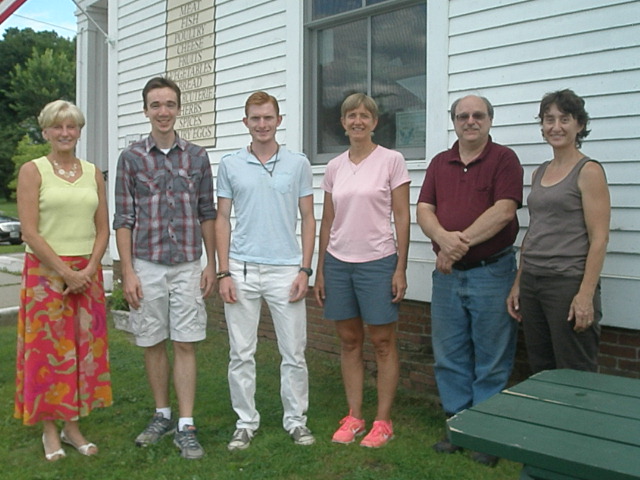
Pictured from left to right: Scholarship Committee Member Susan Wyckoff, Awardees Brian Perry and Levi Frye, (Not pictured is Will Tyson), Committee Members Kim Lewis, Steve Dalessio, and Jan Galoway-LeClerk. (Not pictured is Thomas Goins)
Brian Perry is in his final year at Lehigh University completing an Honors Program in the Integrated Degree of Engineering and Arts and Sciences where he is combining Engineering with Sustainable Development. Additionally, he will stay an extra term to complete necessary classes to earn a cornerstone degree of Mechanical Engineering. Last spring, Brian spent the semester abroad in Copenhagen, Denmark learning Sustainable Urban Design from a world leader in implementing green actions. During this time, he was given access to Parliamentary discussions, learned how to write policy as a state minister, learned the justifications behind building codes and urban transportation strategies, and interviewed city and national officials on the topics of electric vehicles, district heating, and flood protection as Copenhagen and Denmark worked toward their long term goals for 2025 and 2050. This summer, Brian had an internship with the City of Keene where he hoped to integrate engineering, architecture, urban planning, and environmental science to benefit our energy market. Finally, Brian will be completing his senior thesis combining Mechanical Engineering and Sustainable Development focusing on a study of wind turbines and solar panels defining their feasibility of installation for various municipalities.
Levi Frye is entering his sophomore year at the University of Maine, School of Natural Sciences, Forestry and Agriculture, in the Department of Wildlife Ecology. Some of his courses included Biology, Environmental Communication Skill, Introductory Wildlife Resources, Introductory Fisheries Science, and Wildlife Field Trips. This summer he was involved in tracking mountain lions and providing data on sightings for the State of New Hampshire. His goal is to work as a game warden or as a wildlife technician for the National Department of Agriculture. He will be combining his major in wildlife ecology with a minor in law enforcement/criminal justice where he hopes to be able to enforce environmental laws and regulations to protect species for their survival and for us to enjoy.
Will Tyson is getting a Masters in Environmental Science from the University of Victoria in Victoria, British Columbia, Canada. His research involves documenting the impact of a variety of human and environmental disturbances, such as oil exploration or increasing wildfires, on landscapes that indigenous people rely upon for hunting and trapping. This research takes place in the Inuvialuit Settlement Region (ISR) of the western Canadian arctic and is intended to display the impact of environmental change both on fragile ecosystems and the people who rely on them. The ISR is experiencing rapid environmental change. Hydrocarbon exploration has resulted in a greater human footprint in the region and climate change is raising concern over permafrost thawing, an increase in extreme weather events, and a greater frequency and intensity of tundra fires. These disturbances often appear small when studied in isolation, but when combined, can accumulate to represent major environmental change in critical wildlife harvesting areas. Will’s research seeks to identify the extent of these changes in an effort to inform land use management and conservation offices in the region.


 The Walpolean
Leave a comment